If you're running a SaaS, you're probably thinking about how AI agents will interact with your product. The current hype cycle says build an MCP server. If you're a little more tapped in, you've probably moved on to shipping a CLI, like Google's Workspace agent tools. Both are fine. But I think the real play is the SDK.
The core pitch of LangChain was interchangeability. Plug-and-play components. Swap ChatGPT for Anthropic for Gemini for whatever. Replace your vector database, swap out your tools, mix and match to your heart's content. Build agents from standardized Lego bricks. It sounded great.
I think there's still a place for LangGraph for orchestration. But the rest of it? I don't think LangChain makes sense anymore. Here's why.
In the world of AI dev, there’s a lot of excitement around multi-agent frameworks—swarms, supervisors, crews, committees, and all the buzzwords that come with them. These systems promise to break down complex tasks into manageable pieces, delegating work to specialized agents that plan, execute, and summarize on your behalf. Picture this: you hand a task to a “supervisor” agent, it spins up a team of smaller agents to tackle subtasks, and then another agent compiles the results into a neat little package. It’s a beautiful vision, almost like a corporate hierarchy with you at the helm. And right now, these architectures and their frameworks are undeniably cool. They’re also solving real problems as benchmarks show that iterative, multi-step workflows can significantly boost performance over single-model approaches.
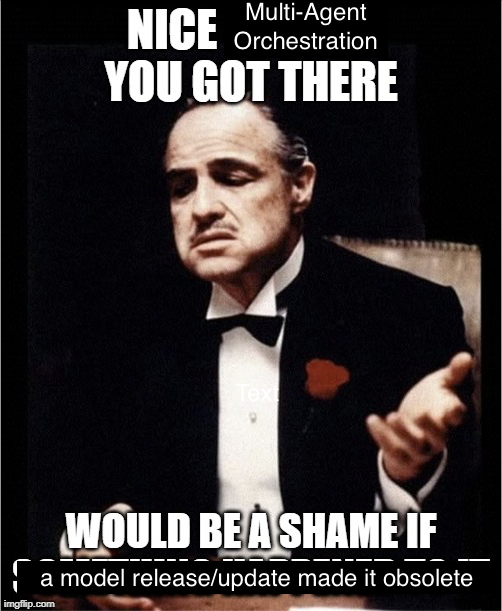
But these frameworks are a temporary fix, a clever workaround for the limitations of today's AI models. As models get smarter, faster, and more capable, the need for this intricate scaffolding will fade. We're building hammers and hunting for nails, when the truth is that the nail (the problem itself) might not even exist in a year. Let me explain why.